
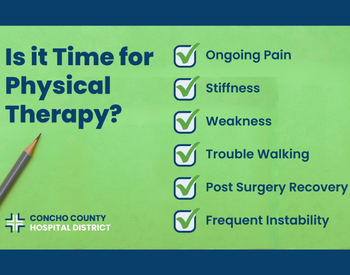
When Should You See a Physical Therapist? 7 Signs It’s Time
Pain doesn’t have to be severe to be a problem. Loss of balance doesn’t have to lead to a fall to matter. And weakness doesn’t have to sideline you before it deserves attention.
Physical therapy is not just for major injuries. It is often the difference between maintaining independence and slowly losing it.
Here are seven signs it may be time to schedule a physical therapy evaluation at Concho County Hospital.
1. Pain That Lasts More Than a Few Weeks
If discomfort in your back, knees, shoulders, or hips feels like more than normal soreness after a workout or physical activity, it may not resolve on its own. Ongoing pain can limit movement and gradually affect strength and balance.
“Pain is often the body’s way of signaling that something is not moving or functioning correctly,” says Christine Maligaya, DPT. “The sooner we assess it, the easier it is to correct the underlying issue.”
2. Trouble With Balance or Feeling Unsteady
If you feel unsure on uneven ground, avoid stairs, or hold onto furniture while walking, your balance may need attention. Balance issues increase fall risk, especially as we age.
Physical therapy can strengthen stabilizing muscles and retrain safe movement patterns before a fall occurs.
3. Limited Range of Motion
If you cannot fully lift your arm, bend your knee, or turn your neck without stiffness, that restriction can affect daily activities like dressing, driving, or reaching overhead.
Restoring mobility and proper function helps prevent compensating movements that create new problems.
4. Muscle Weakness After Illness or Surgery
After surgery, hospitalization, or prolonged inactivity, strength can decline quickly. Even a short hospital stay can lead to de-conditioning or loss of muscle tone and strength.
“Rebuilding strength safely and progressively is critical,” says Christine Maligaya, DPT. “We guide patients through structured recovery so they don’t overdo it or fall behind.”
5. Difficulty Walking or Moving Safely
If walking feels slower, more tiring, or less stable than it used to, it’s worth evaluating. Changes in gait can signal weakness, joint limitations, or neurological concerns.
Physical therapy focuses on safe movement, endurance, and confidence.
6. Frequent Stiffness or Joint Instability
Joints that feel unstable, lock up, or repeatedly “give out” may need strengthening and stabilization work. Ignoring these signs increases the chance of injury.
7. You Want to Prevent Further Injury
Physical therapy is not only reactive. It’s preventive. Whether you work on a ranch, spend long hours standing, or simply want to stay active, strengthening and movement retraining reduce future risk.
“We don’t just focus on short-term relief,” says Christine Maligaya, DPT. “Our goal is long-term independence and safe movement for everyday life.”
What to Expect
Every patient at Concho County Hospital Physical Therapy receives one-on-one care. Treatment begins with a full evaluation and a personalized plan designed around your specific goals, limitations, and daily activities.
If you are experiencing pain, weakness, balance concerns, or mobility challenges, it may be time to schedule an evaluation.
Call 325-869-5911 to learn more or schedule your appointment.